
Introduction
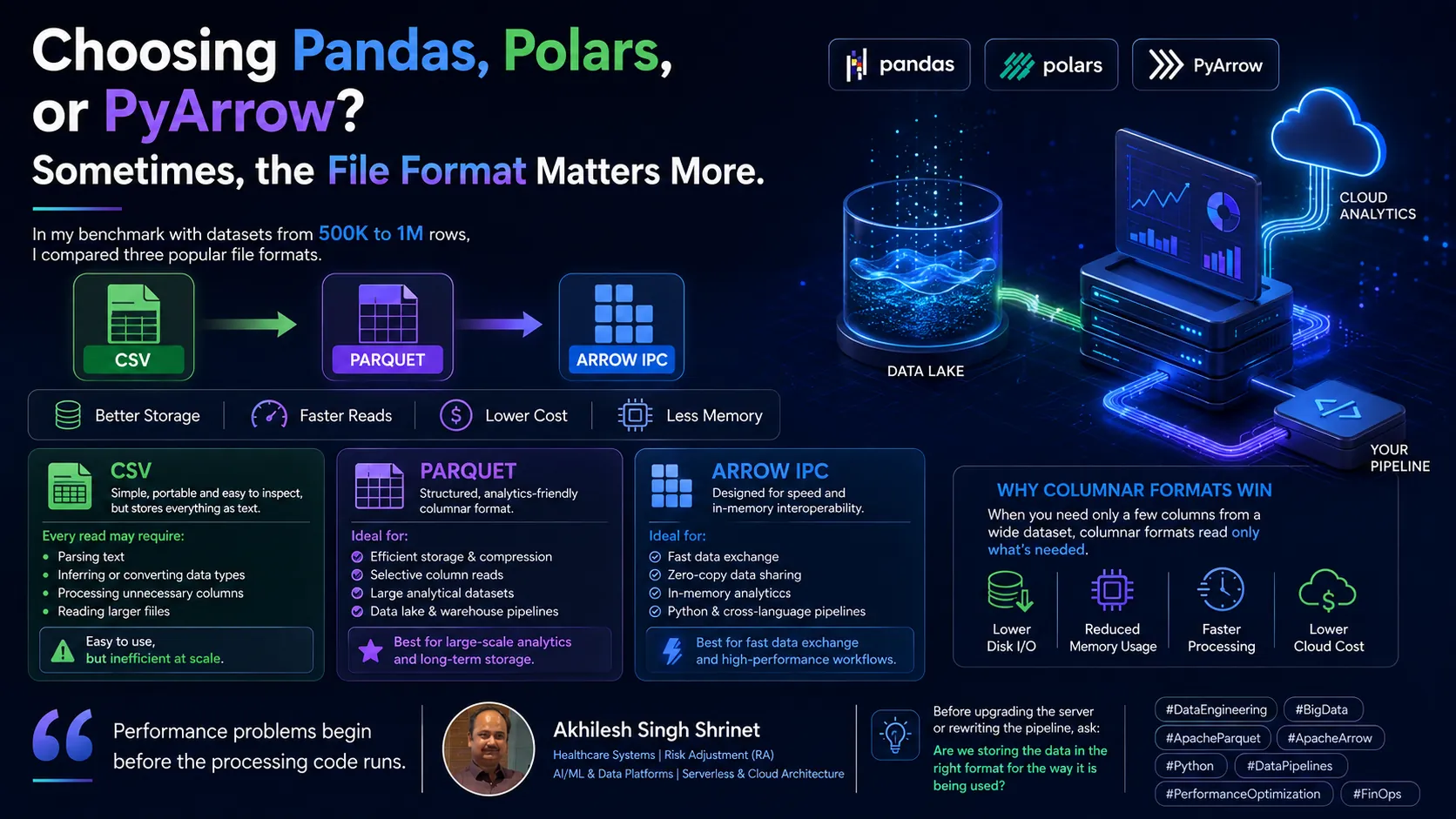
When developers discuss high-performance data processing in Python, the conversation usually centers around Pandas, Polars, or PyArrow. While selecting the right DataFrame library is important, my recent benchmark reminded me of a more fundamental truth:
Performance problems often begin before your processing code runs.
If your data is stored inefficiently, even the fastest DataFrame library must spend valuable time parsing, converting, and loading unnecessary data before any meaningful computation begins.
In this article, I’ll explain why choosing the right file format—CSV, Apache Parquet, or Apache Arrow IPC (Feather)—can have a greater impact on performance than simply switching DataFrame libraries.
The Benchmark
To better understand the impact of file formats, I conducted a benchmark using datasets ranging from 500,000 to 1 million rows in Python with PyArrow.
The benchmark compared three widely used storage formats:
- CSV
- Apache Parquet
- Apache Arrow IPC (Feather)
Rather than focusing solely on raw speed, I evaluated how each format affects real-world analytical workloads.
The results reinforced an important lesson:
The way you store data directly influences how efficiently you can process it.
Why CSV Becomes a Bottleneck
CSV has been the industry’s default exchange format for decades.
It’s easy to read.
It’s human-friendly.
Almost every programming language supports it.
But CSV stores everything as plain text.
Every time your application loads a CSV file, it typically needs to:
- Parse text into structured values
- Infer data types
- Convert strings into integers, floats, or dates
- Read every column, even when only a few are needed
- Process comparatively larger files
These operations increase:
- CPU usage
- Disk I/O
- Memory consumption
- Processing time
The larger your dataset becomes, the more noticeable these costs become.
Why Columnar Formats Are Faster
Unlike CSV, Apache Parquet and Apache Arrow IPC are columnar storage formats.
Instead of storing data row by row, they organize data by columns.
This simple architectural difference unlocks several advantages.
Apache Parquet
Parquet is designed for analytical workloads.
It provides:
- Efficient compression
- Column projection
- Predicate pushdown
- Reduced storage costs
- Excellent compatibility with Spark, DuckDB, Snowflake, BigQuery, and modern data lakes
For cloud-native architectures, Parquet has become the de facto standard.
Apache Arrow IPC (Feather)
Arrow IPC focuses on speed.
Instead of repeatedly serializing and deserializing datasets, applications can exchange data almost instantly.
Arrow is ideal for:
- Python workflows
- Jupyter notebooks
- Machine Learning
- AI pipelines
- In-memory analytics
If Parquet is optimized for storage, Arrow is optimized for movement.
Column Projection: The Hidden Performance Feature
Suppose your dataset contains 50 columns, but your application only needs 5.
With CSV, the entire file must still be read.
With Parquet, only the required columns are loaded.
That means:
- Lower disk I/O
- Less memory usage
- Faster queries
- Lower cloud costs
For dashboards, analytics platforms, and ETL pipelines, this optimization can save significant compute resources over time.
It’s Not Always About Pandas vs. Polars
The Python community often compares:
- Pandas
- Polars
- PyArrow
Each library has its strengths.
However, changing libraries doesn’t eliminate the cost of reading inefficient data.
Even the fastest DataFrame engine still has to process whatever file format you provide.
This is why performance tuning should start with architecture—not just libraries.
Questions Worth Asking
Before upgrading servers or rewriting your data pipeline, consider these questions:
- Are we storing data in the right format?
- Do we really need CSV for analytical workloads?
- Can columnar storage reduce our cloud costs?
- Are we reading data we never use?
- Could Parquet or Arrow simplify our architecture?
Often, these architectural decisions produce larger performance gains than switching libraries.
Final Thoughts
The biggest takeaway from my benchmark wasn’t that one DataFrame library is universally faster than another.
It was this:
Choosing the right file format can have a bigger impact than choosing the right DataFrame library.
CSV still has its place for interoperability and simple data exchange.
But if you’re building analytics platforms, machine learning systems, or modern cloud-native data pipelines, Apache Parquet and Apache Arrow are worth serious consideration.
The best-performing systems aren’t always built with the fastest libraries—they’re built on the right architectural decisions.
About the Author
Akhilesh Singh Shrinet is a Software Architect specializing in Healthcare Systems, Risk Adjustment (RA), AI/ML, Data Engineering, and Serverless Cloud Architecture. Through this blog, he shares practical benchmarks, architectural insights, and real-world engineering solutions to help developers build scalable, high-performance software systems.